Pulse assessment has been practiced in multiple traditional medical systems for centuries, including Ayurveda and Traditional Chinese Medicine. While modern medicine primarily uses pulse measurement to assess heart rate and rhythm, classical systems interpret qualitative features of the pulse to gain broader insights into systemic health. In contemporary integrative settings, pulse diagnosis is considered a supportive clinical tool rather than a replacement for laboratory investigations or imaging studies.
In Ayurveda, pulse examination is referred to as Nadi Pariksha. It forms part of a broader diagnostic framework that also includes observation, questioning, and physical examination. The goal is to assess the balance of the three doshas Vata, Pitta, and Kapha which are understood in Ayurvedic physiology as regulatory principles governing movement, metabolism, and structure.
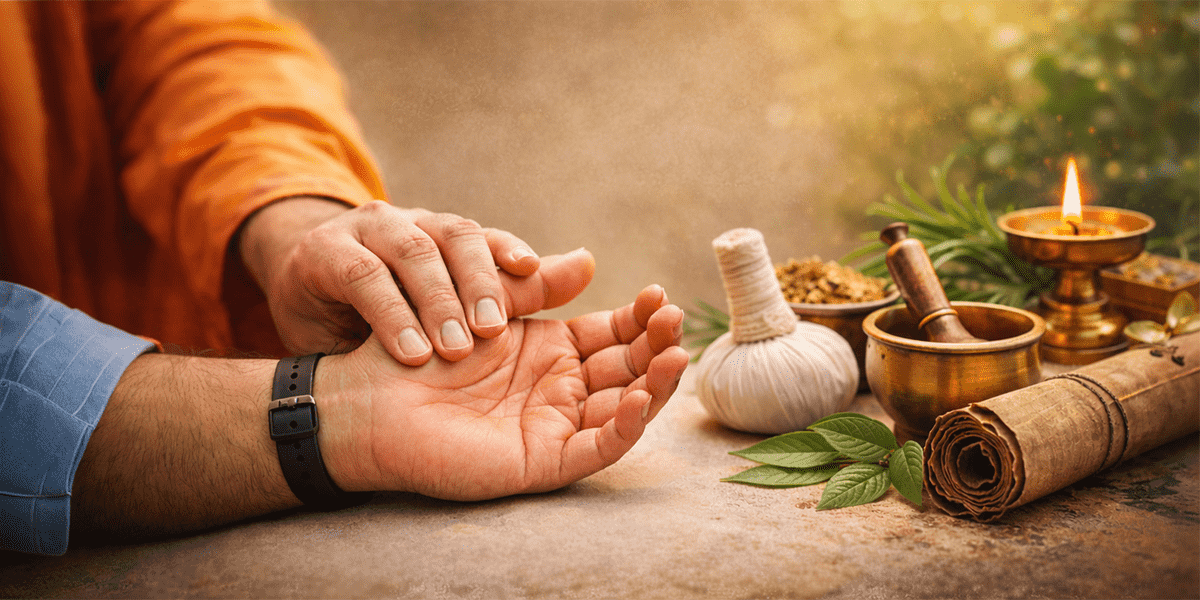
Ayurvedic practitioners assess the pulse at the radial artery using specific finger placements. The qualities perceived such as rhythm, force, temperature, and subtle variations—are interpreted within the context of the individual’s constitution (Prakriti) and current imbalance (Vikriti). Unlike modern cardiovascular pulse assessment, Ayurvedic pulse diagnosis does not focus solely on rate or arrhythmia. It aims to detect patterns suggestive of doshic predominance or disturbance.
In Ayurvedic theory, Vata is associated with movement and nervous system regulation, Pitta with metabolism and transformation, and Kapha with structure and stability. Imbalances are believed to manifest in characteristic pulse qualities.
For example, a Vata-predominant pulse may be described as irregular or light, a Pitta pulse as sharp or bounding, and a Kapha pulse as steady and slow. These interpretations are part of traditional clinical training and are used to guide dietary, lifestyle, and therapeutic recommendations. It is important to clarify that these pulse qualities are conceptual within Ayurvedic physiology and are not equivalent to biomedical cardiovascular findings.
Traditional Chinese Medicine (TCM) also uses pulse examination as a diagnostic tool. In TCM, the pulse is assessed at multiple positions corresponding to organ systems and meridians. The emphasis is on evaluating the flow of qi, or vital energy, within specific organ networks. While both systems value subtle pulse variations, their interpretative frameworks differ significantly. Ayurveda centers on doshic balance and digestive-metabolic strength, whereas TCM emphasizes meridian pathways and organ-energy relationships. Both systems require extensive training and clinical experience.
Ayurveda describes naadis as channels through which physiological and energetic processes occur. In classical texts, pulse examination is understood as a way to assess the flow of vital energy, or prana, within these channels. From a modern biomedical perspective, there is no direct anatomical equivalent to naadis. However, integrative interpretations often view these concepts metaphorically, representing regulatory systems such as circulation, nerve signaling, and metabolic function.Pulse assessment is therefore best understood as a traditional interpretive method within a specific philosophical framework.
Ayurvedic and yogic philosophy describe five layers, or koshas, representing different dimensions of human existence: the physical body, energy layer, mental layer, intellectual layer, and deeper consciousness layer. While pulse examination primarily relates to the physical and energetic interpretations, practitioners may incorporate broader observations about mental and emotional state into clinical evaluation. Stress, anxiety, and fatigue can influence pulse characteristics in measurable physiological ways, even in modern medicine. However, claims that pulse diagnosis can predict lifespan or specific life events are not supported by scientific evidence and should be approached cautiously.
In modern integrative settings, pulse diagnosis may serve as a complementary observational tool alongside laboratory testing, imaging, and standard clinical examination. It may help guide individualized lifestyle recommendations consistent with Ayurvedic principles. For example, dietary adjustments, stress management practices, and herbal formulations may be recommended based on perceived doshic imbalance. These interventions should be considered supportive and tailored to the patient’s overall medical condition.
Pulse diagnosis reflects the depth and historical sophistication of traditional medical systems. It represents an attempt to understand the body as an interconnected whole rather than as isolated organs. In contemporary healthcare, it can be appreciated as part of a holistic assessment model. When integrated responsibly with evidence-based medicine, it may contribute to a broader understanding of patient well-being. The strength of pulse diagnosis lies not in technological measurement, but in attentive clinical observation within a structured traditional framework.
This article is intended for educational purposes only and does not constitute medical advice. Pulse diagnosis is a traditional assessment method and should not replace evidence-based medical evaluation. Individuals with health concerns should seek appropriate medical consultation and diagnostic testing.