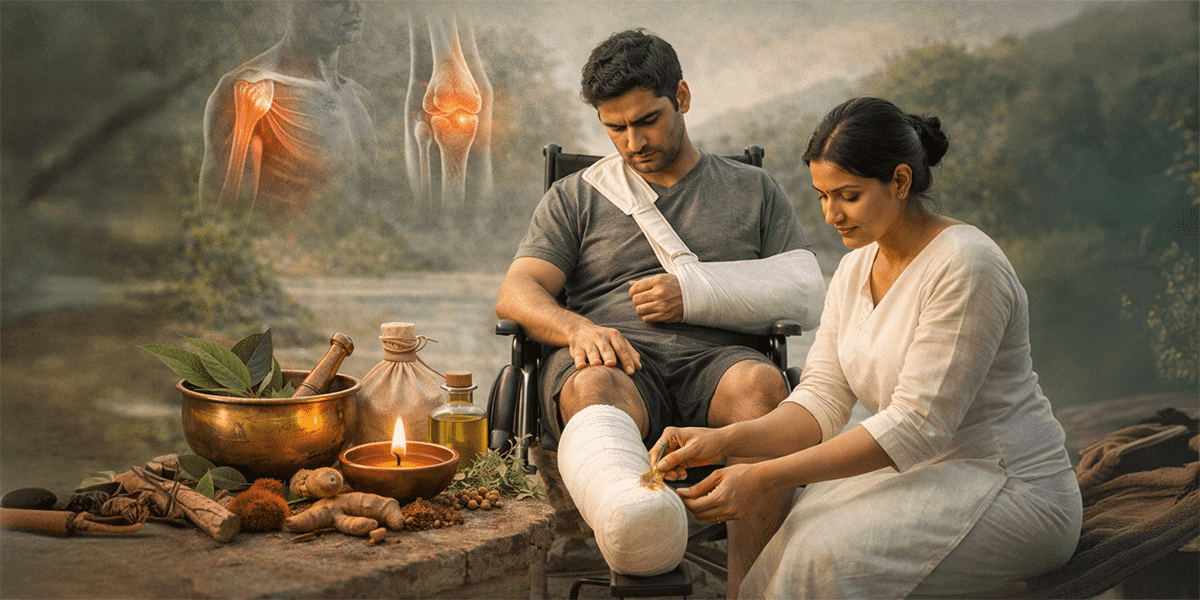
Accidents can result in fractures, ligament injuries, muscle trauma, nerve involvement, and internal soft tissue damage. While emergency and surgical care are critical in the acute phase, recovery frequently continues for months. Many individuals experience lingering stiffness, weakness, scar-related discomfort, or chronic pain even after radiological healing has occurred.
Modern rehabilitation focuses on structured physiotherapy, inflammation control, nutritional optimization, and gradual return to function. Pain after trauma is now understood to involve not only tissue injury but also inflammatory signaling and sometimes altered nervous system sensitivity. Effective recovery therefore requires a comprehensive and patient-specific plan.
Ayurveda includes traditional descriptions of trauma care within branches such as Bhagna Chikitsa, which addresses fractures, and Shalya Tantra, which relates to surgical sciences. In a contemporary setting, Ayurvedic approaches may be considered supportive during rehabilitation, provided conventional medical management remains central.
Classical Ayurvedic texts describe fractures as disruptions in bone continuity accompanied by swelling, deformity, and pain. Traditional management emphasized alignment, stabilization, rest, and nourishment. These principles align broadly with modern orthopaedic practice, which requires imaging, immobilization, and sometimes surgical fixation.
It is important to emphasize that Ayurvedic therapy does not replace emergency orthopaedic care. Fractures, internal bleeding, head injuries, and complex trauma must always be managed in hospital settings using evidence-based medical protocols. However, once fractures are stabilized and acute inflammation subsides, certain supportive therapies may be considered to improve mobility and reduce residual stiffness.
Even after bones unite and wounds close, patients may experience muscular tightness, restricted joint motion, scar tissue adhesions, and reduced strength. Chronic post-traumatic pain is recognized in modern medicine as multifactorial, involving inflammation, altered biomechanics, and sometimes central sensitization (Woolf, 2011).
Ayurveda interprets persistent post-injury stiffness and dryness as features associated with Vata imbalance. Although framed differently, both systems acknowledge the importance of restoring circulation, neuromuscular coordination, and tissue nourishment during rehabilitation.
Oil-based therapeutic applications, traditionally known as Abhyanga, are used in Ayurvedic practice to support circulation and muscular relaxation. From a biomedical perspective, massage therapy has demonstrated short-term benefits in reducing musculoskeletal pain and improving subjective recovery (Furlan et al., 2015). Gentle heat-based therapies may further improve blood flow and decrease stiffness in non-acute stages.
These interventions should only be introduced after medical clearance. In cases of unresolved swelling, unstable fractures, infection, or acute inflammation, heat-based or pressure-based therapies may be contraindicated.
Certain herbal oils used traditionally contain botanicals such as turmeric and Boswellia, which have documented anti-inflammatory properties (Hewlings & Kalman, 2017; Sengupta et al., 2008). However, topical application should only be considered once wounds have healed and under appropriate supervision.
In selected cases, structured Ayurvedic programs may be introduced during later phases of recovery. These may include oil therapies, mild sweating procedures, and supportive internal treatments aimed at restoring digestive and metabolic balance after prolonged immobility.
Research on Panchakarma in trauma rehabilitation remains limited. Some small integrative studies suggest improvements in inflammatory markers and quality-of-life measures following Ayurvedic lifestyle interventions (Peterson et al., 2016). However, large randomized trials specific to post-accident recovery are lacking. Intensive detoxification procedures are not appropriate in early trauma recovery, in individuals with anemia, infection, weakness, or ongoing systemic illness. Careful medical evaluation is essential before initiating such programs.
Muscle and bone healing are biologically complex processes that require adequate protein intake, sufficient caloric availability, and key micronutrients such as vitamin D and calcium to support cellular repair and bone remodeling. Systemic metabolic health and nutritional status significantly influence the fracture healing process, and deficiencies may impair recovery and delay functional restoration (Einhorn & Gerstenfeld, 2015).
Ayurveda similarly emphasizes nourishment during convalescence. Easily digestible but nutrient-dense meals are traditionally recommended to support tissue regeneration. Modern research supports balanced anti-inflammatory diets rich in whole foods to reduce systemic inflammatory burden (Calder, 2017). Equally important is structured physiotherapy. Gradual mobilization improves muscle strength, joint lubrication, and neuromuscular coordination. Without guided rehabilitation, stiffness and weakness may persist even after structural healing is complete.
Recovery after trauma is gradual and individualized. Conventional medicine provides essential surgical stabilization, imaging, and acute care. Physiotherapy ensures functional restoration. Nutritional optimization supports tissue repair. Ayurvedic therapies, when applied responsibly and in coordination with medical supervision, may serve as complementary interventions aimed at reducing stiffness, supporting metabolic balance, and improving overall well-being during rehabilitation. They are not substitutes for orthopaedic evaluation, surgical care, or structured rehabilitation programs.The primary objective in post-accident recovery is safe, sustained restoration of function rather than rapid or guaranteed outcomes.
Calder, P.C. (2017). Omega-3 fatty acids and inflammatory processes. [LINK]
Furlan, A.D. et al. (2015). Massage for low-back pain. [LINK]
Hewlings, S.J. & Kalman, D.S. (2017). Curcumin: A review of its effects on human health. [LINK]
Peterson, C.T. et al. (2016). Identification of altered metabolomic profiles following a Panchakarma-based intervention. [LINK]
Einhorn, T.A. & Gerstenfeld, L.C. (2015). Fracture healing: Mechanisms and interventions. [LINK]
Sengupta, K. et al. (2008). Boswellia serrata extract in osteoarthritis. [LINK]
Woolf, C.J. (2011). Central sensitization: Implications for the diagnosis and treatment of pain. [LINK]
This article is intended for educational purposes only and does not constitute medical advice. Fractures, internal injuries, and post-accident conditions require proper clinical evaluation and management. Ayurvedic therapies should only be undertaken after medical clearance and under qualified supervision. They are complementary to, not replacements for, emergency, surgical, or rehabilitative care.